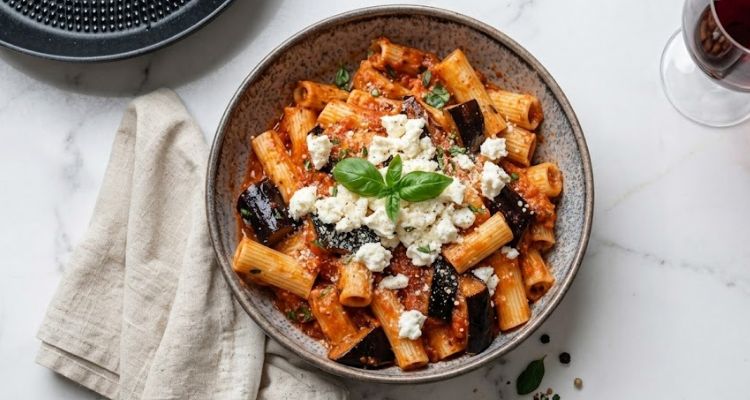
Giada pasta alla norma from Giada De Laurentiis roasts salted eggplant at 450°F and tosses it with short pasta in a San Marzano tomato sauce finished with ricotta salata. And the dish serves 6 at approximately 520 calories per serving in about 55 minutes, since the eggplant roasts while the sauce simmers.
Most alla norma recipes fry the eggplant in a pool of oil on the stovetop, but Giada roasts it on a sheet pan at high heat instead. So the slices brown evenly with less oil, and they hold their shape in the finished pasta instead of collapsing into greasy pieces.
Salting the eggplant slices and letting them sit for 15 minutes before roasting is the step that draws out bitter moisture. And if you skip it, the water trapped inside steams the eggplant in the oven instead of browning it, so the pieces come out soft and pale rather than caramelized.
Source: Giada De Laurentiis (Giadzy.com)
Giada Pasta Alla Norma
Course: DinnerCuisine: AmericanDifficulty: Easy6
servings25
minutes30
minutes520
kcalSalted eggplant half-moons roast at 450°F until browned while garlic, red pepper flakes, San Marzano tomatoes, and oregano simmer into a quick sauce. Then short pasta finishes cooking directly in the sauce with Parmigiano, and the roasted eggplant folds in with torn basil and grated ricotta salata on top.
Ingredients
- For the eggplant:
3 Japanese eggplants, sliced into 1/3-inch half-moons
1 teaspoon kosher salt
1/4 cup olive oil
- For the tomato sauce:
2 tablespoons olive oil
3 garlic cloves, smashed and peeled
1/2 teaspoon red pepper flakes
1 (28-oz.) can chopped San Marzano tomatoes
1/2 teaspoon kosher salt
1/2 teaspoon dried oregano
- For the pasta:
1 pound short tube pasta such as rigatoni or ziti
1 cup freshly grated Parmigiano Reggiano cheese
1/2 cup torn basil leaves (from 2 stems)
1 cup coarsely grated ricotta salata
Directions
- Preheat the oven: Heat to 450°F.
- Salt the eggplant: Then place the slices in a colander, season with 1 teaspoon salt, and let sit for 15 minutes.
- Dry the eggplant: After 15 minutes, spread the slices on a clean towel and wring out any excess moisture.
- Roast the eggplant: Then spread on a rimmed baking sheet, toss with 1/4 cup olive oil, and roast for 20 to 30 minutes until browned, stirring halfway.
- Start the sauce: While the eggplant roasts, heat 2 tablespoons olive oil in a large skillet over medium heat.
- Cook the garlic: Then add the smashed garlic and cook until fragrant, about 1 minute.
- Add the tomatoes: Once fragrant, add the red pepper flakes, tomatoes, remaining 1/2 teaspoon salt, and oregano.
- Simmer the sauce: Then bring to a simmer and cook for about 15 minutes, stirring often, until slightly reduced.
- Boil the pasta: Meanwhile, cook the pasta in generously salted boiling water for 1 minute less than the package directs.
- Transfer to the sauce: Then scoop the pasta directly from the water into the tomato sauce with a spider or strainer.
- Add pasta water and cheese: Once in the sauce, add 1/2 cup pasta water and sprinkle the Parmigiano directly onto the bare pasta.
- Finish in the sauce: Then toss well and simmer over medium heat for 2 to 3 more minutes until al dente, adding more pasta water if needed.
- Fold in the eggplant: Once the pasta is coated, toss in the roasted eggplant and torn basil.
- Serve: Then plate and top with grated ricotta salata and a drizzle of olive oil.
FAQs
What is ricotta salata and can I substitute it?
Ricotta salata is a firm, salted sheep’s milk cheese that grates in dry, crumbly shavings over the finished pasta. And it tastes sharper and saltier than fresh ricotta, so the two are not interchangeable despite sharing a name.
But if you cannot find ricotta salata, feta crumbled by hand gives a similar salty tang, though the texture is softer. And Pecorino Romano grates more finely, so use half the amount since it is saltier and melts into the sauce instead of sitting on top.
Why does the pasta cook 1 minute less than the package says?
The pasta finishes cooking directly in the tomato sauce for another 2 to 3 minutes, so pulling it early keeps it from turning mushy. And the starchy pasta water that clings to each piece helps the sauce emulsify with the Parmigiano into a creamy coating.
This same undercook-and-finish technique appears in the giada bison bolognese, where pappardelle goes 2 minutes short before tossing in the meat sauce. Since both recipes rely on the sauce to carry the final cook, starting with fully cooked pasta would leave you with overcooked, soft noodles.
Can I use regular eggplant instead of Japanese?
Japanese eggplants are thinner with fewer seeds, so they roast faster and taste less bitter than globe eggplant. But standard globe eggplant works if you slice it into similar-sized half-moons and extend the roasting time by 5 to 10 minutes.
And the salting step matters even more with globe eggplant, because the larger variety holds more bitter liquid. So give it the full 15 minutes in the colander and press firmly with the towel before tossing with oil.
Can I make the sauce ahead?
The tomato sauce stores in the fridge for up to 3 days and actually tastes richer after sitting overnight. And the roasted eggplant holds in a separate container for 2 days, since reheating it in the hot sauce softens it back to the right texture.
But cook the pasta fresh each time, because reheated pasta absorbs all the sauce and turns starchy and dry. Since boiling and finishing in the sauce takes under 15 minutes, fresh noodles are worth the small effort.
What should I serve alongside this?
The pasta is a full main course on its own, so keep sides light and simple. And a peppery arugula salad with lemon and shaved Parmigiano balances the rich tomato sauce without adding more starch.
For a full Giada dinner, start with the giada orzo salad as an antipasto, because the crispy fried orzo contrasts the soft pasta in the main course. But skip bread alongside, because the starchy tube pasta and thick sauce already cover that role on the plate.