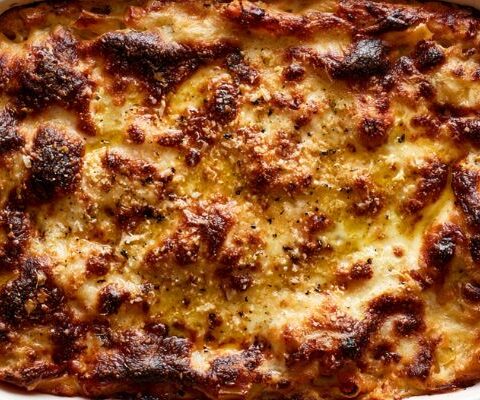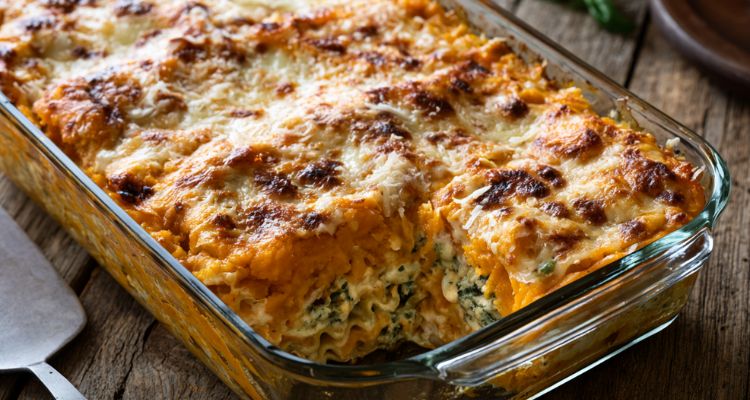
Giada’s Butternut Squash Lasagna layers a sweet squash puree blended with crushed amaretti cookies, a basil-scented béchamel, and two Italian cheeses between no-boil noodles for a rich vegetarian main course ready in about 2 hours.
This recipe lives on giadzy.com, where Giada designed it as a vegetarian centerpiece that captures fall in a single baking dish. She calls out the combination of sweet butternut puree and a fresh basil béchamel as what pulls the whole thing together.
Blending crumbled amaretti cookies into the squash puree is the move that separates this from every other butternut lasagna. The cookies add a faint almond sweetness and thicken the puree so it holds between noodle layers instead of turning watery during the 55-minute bake.
Giada Butternut Squash Lasagna
Course: Pasta, DinnerCuisine: American, ItalianDifficulty: Easy6
servings30
minutes1
hour25
minutes420
kcal1
hour55
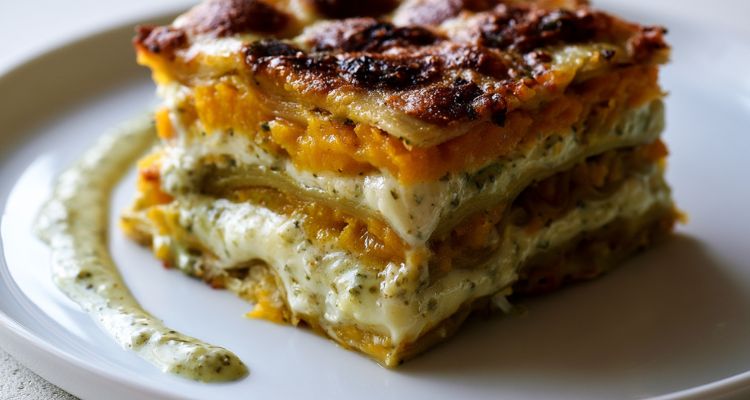
minutesNo-boil noodles stacked with an almond-kissed squash filling and a green-flecked basil white sauce, topped with mozzarella and Parmesan and baked until the edges bubble and the cheese browns. A hands-off vegetarian centerpiece for cooler nights.
Ingredients
- Squash Puree:
1 tablespoon (15ml) olive oil
1 1/2 to 2 lb (680-900g) butternut squash, peeled, seeded, and cut into 1-inch cubes
Salt and freshly ground black pepper
1/2 cup (120ml) water
3 amaretti cookies, crumbled
- Basil Béchamel:
1/4 cup (57g) butter, plus more for the dish
1/4 cup (30g) all-purpose flour
3 1/2 cups (830ml) whole milk
Pinch of nutmeg
3/4 cup (18g) lightly packed fresh basil leaves
Salt and freshly ground black pepper
- Assembly:
12 no-boil lasagna noodles
2 1/2 cups (280g) shredded whole-milk mozzarella
1/3 cup (33g) grated Parmesan
Directions
- Cook the squash. Heat oil in a large skillet over medium-high. Add squash cubes, season with salt and pepper. Pour in 1/2 cup (120ml) water, cover, and simmer over medium heat until tender, stirring occasionally, about 20 minutes.
- Make the puree. Cool the squash slightly, then transfer to a food processor with the crumbled amaretti cookies. Blend until smooth and season to taste.
- Build the béchamel. Melt butter in a medium saucepan over medium heat. Whisk in flour for 1 minute, then gradually whisk in milk. Raise heat to medium-high and bring to a boil, then reduce to medium and simmer, whisking often, until slightly thickened, about 5 minutes. Stir in the nutmeg.
- Blend in the basil. Cool the sauce slightly. Transfer half to a blender, add the basil leaves, and blend until smooth. Pour back into the remaining sauce and stir to combine. Season with salt and pepper.
- Preheat the oven to 375°F (190°C) with the rack centered.
- Layer the lasagna. Butter a 13x9x2 inch (33x23x5 cm) glass baking dish. Spread 3/4 cup (180ml) sauce on the bottom. Lay 3 noodles over the sauce. Spread one-third of the squash puree over the noodles, sprinkle with 1/2 cup (56g) mozzarella, and drizzle 1/2 cup (120ml) sauce on top. Repeat layering three more times.
- Bake covered. Cover tightly with foil and bake for 40 minutes.
- Finish uncovered. Remove foil, sprinkle remaining mozzarella and Parmesan on top, and bake until the sauce bubbles and the cheese turns golden, about 15 minutes more.
- Rest and serve. Let stand 15 minutes before slicing so the layers hold together.
Notes
- An immersion blender can replace a regular blender for both the squash puree and the basil béchamel.
- When blending hot béchamel: let it cool at least 5 minutes, fill the blender no more than halfway, release one corner of the lid, and cover with a towel before pulsing to prevent steam pressure from pushing the lid off.
FAQs
Why does Giada add amaretti cookies to the squash puree?
The cookies bring a faint almond sweetness that rounds out the squash’s natural sugar without adding any liquid. Ground almonds in the cookies also thicken the puree so it stays firm between noodle layers.
Without them the filling runs thin and one-note sweet, which means it slides out the side when you cut a slice. Three cookies is all it takes, so the almond flavor stays in the background rather than overpowering the squash.
Why blend basil into only half the béchamel?
Blending all the sauce with basil would turn the entire béchamel bright green and push the herb flavor too far forward. Mixing only half keeps the basil present but balanced against the creamy white sauce.
The marbled effect also gives the finished lasagna visual contrast, with streaks of green running through pale cream between the orange squash layers. That same idea of balancing one bold flavor against a milder base shows up in her Lemon Spaghetti too.
Can you use regular lasagna noodles instead of no-boil?
You can, but boil them until just barely tender first, then drain and lay them flat on an oiled baking sheet so they don’t stick. Overcooked noodles fall apart under the weight of the puree and cheese during the long bake.
No-boil noodles absorb moisture from the béchamel and squash puree as they cook, which is why Giada designed the sauce ratios around them. Swapping in boiled noodles may leave the dish slightly drier since those sheets absorb less liquid.
Why does the foil come off for the last 15 minutes?
The 40 minutes under foil lets the noodles steam and soften fully while the sauces melt into the layers. Keeping the cover on the entire time would leave the top pale and soggy with no browned cheese crust.
Those final uncovered minutes at 375°F (190°C) brown the mozzarella and Parmesan and evaporate excess moisture so the lasagna holds its shape when you slice into it.
How should you store leftover butternut squash lasagna?
Cover the dish tightly with foil or transfer slices to an airtight container and refrigerate within two hours. Leftovers keep for 3 to 4 days and reheat at 350°F (180°C) covered with foil until warmed through, about 25 minutes.
For freezing, wrap individual portions in plastic wrap, then seal in a freezer bag for up to 2 months. Thaw overnight in the fridge before reheating so the center heats evenly. For a light finish after this rich lasagna, Giada’s Tiramisu is a natural Italian pairing.